Everybody's got inspirations and muses for the work that they do. I think I may have uncovered the inspiration for one of my monk-art-mentors.
This entry originally appeared in August of 2024 on my “other” newsletter. I wanted to preserve it here because it surely connects with the art theme. Enjoy it again, maybe for the first time!
Saintspeak
“The times are never so bad that a good man cannot live in them.”
– St. Thomas Aquinas
Found Thoughts
It’s always a bit of a shock to see one’s artistic influences in unexpected places. I was standing in front of the tomb of Saints Benedict and Scholastica on a recent trip to Italy. From the staircase, to the walls, to the ceiling, an art style that I knew incredibly well was staring right back at me in that chapel. But I had never seen, much less visited, The Abbey of Monte Cassino high up in the mountains. So, why was it so strikingly familiar?
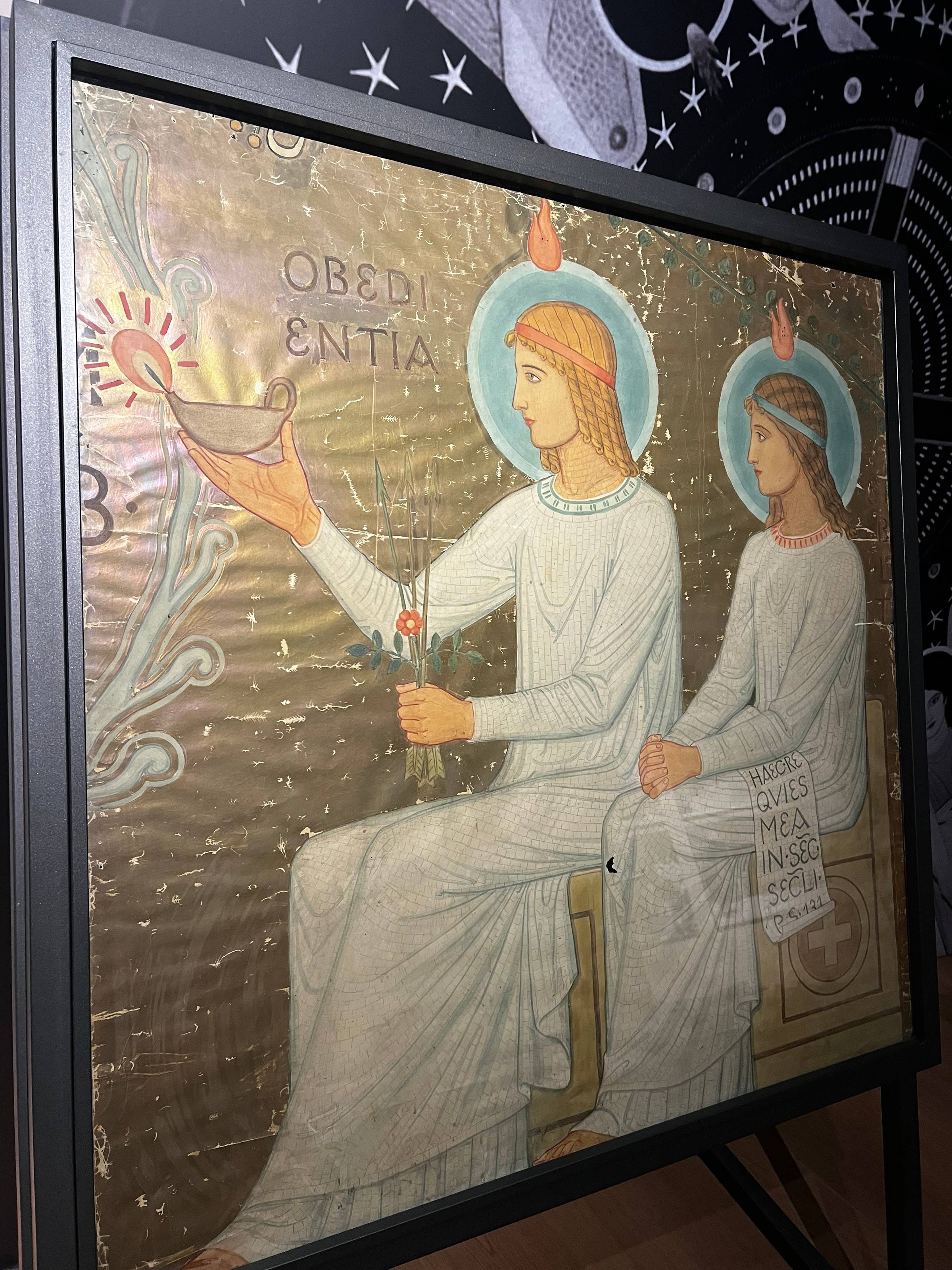
The Personification of Holy Obedience at Montecassino Abbey “This is my rest forever and ever” Psalm 131
“Nothing is really new…” is one of the principles in Austin Kleon’s excellent book Steal Like an Artist . The overall idea is that a creative person should learn about his or her “idols” and then learn about the influences and people that impacted them.
Looking at the walls of the chapel, I recognized that I knew this art because I had seen the work of someone who “stole” the look from this ancient place, a Dutch Benedictine monk that only spent about a decade in The United States. A Dutch monk? Let me explain.
The Benedictine priest Dom Gregory de Wit (“Dom” is the word we would translate as “Father”) was recruited by Abbot Columban Thuis of Saint Joseph Abbey to paint murals in the monk’s refectory (dining hall). He would go on to illuminate the abbey church using his unique style, which seems to blend eastern iconography with his own quirky style of slightly enlarged hands and feet and expertly executed anatomy and musculature. While de Wit’s projects concluded in 1955, and he died in Switzerland nearly 50 years later, I got to know his work for 4 years as a student in the very same abbey where he had shared his talents.
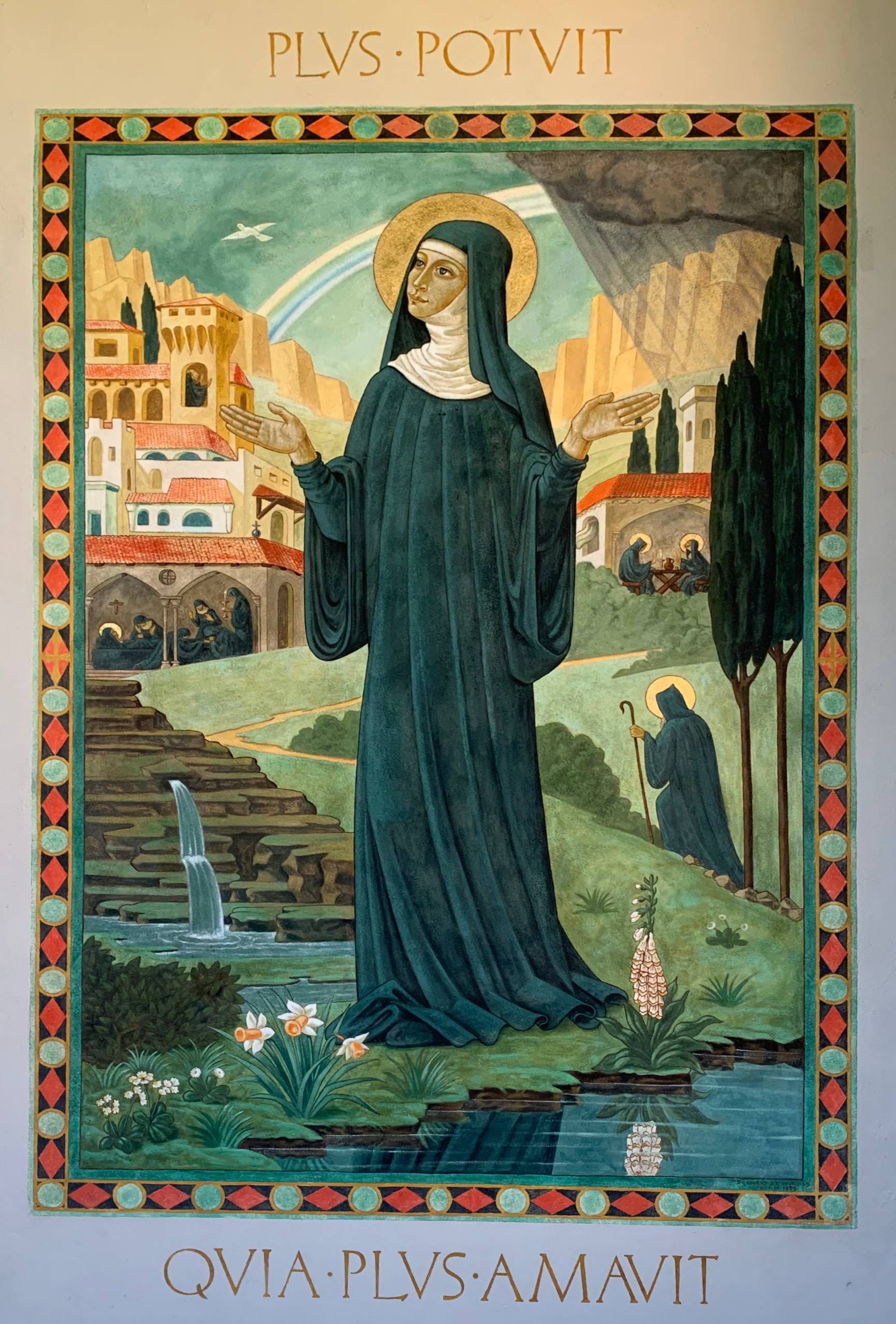
The story of Sts. Scholastica and Benedict in the side chapel of Saint Joseph Abbey by Dom Gregory deWit
”She could do more, because she loved more.” It’s an excellent story I may tell later!
Apparently his uniqueness didn’t come from nowhere, nor was it simply an academic application of skill. I don’t know for sure, but these reliefs and frescoes in Monte Cassino had to have been studied by him!
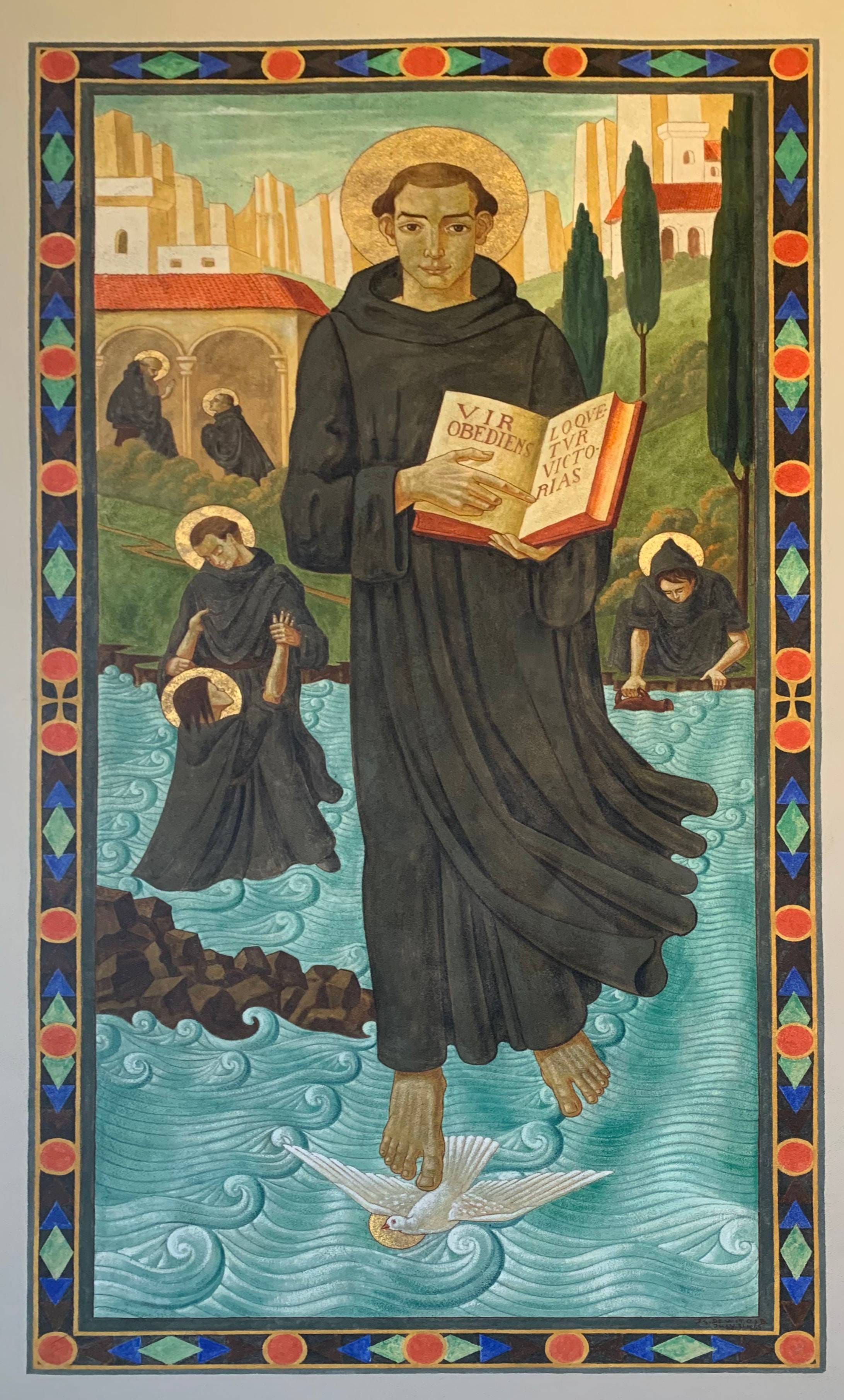
A side chapel dedicated to St. Maurus (another excellent story!) at Montecassino Abbey Notice the style!
I admit it’s supposition on my part and coincidence isn’t necessarily cause, but to see art just jump out and immediately make parallel connections in my mind was a moment of deep connection and even of deep prayer. There’s something about spanning the globe with a paintbrush and a shared imagination. When one considers that all the baptized are part of the Mystical Body of Christ, it’s possible to think in terms like St. Paul suggests: “For just as the body is one and has many members, and all the members of the body, though many, are one body, so it is with Christ.“ (1 Cor 12:12) The image then gets very literal: “If the whole body were an eye, where would the hearing be? If the whole body were hearing, where would the sense of smell be? But as it is, God arranged the members in the body, each one of them, as he chose. If all were a single member, where would the body be? As it is, there are many members, yet one body.” (1 Cor 12:17–20)
But, it stands to reason that what lay behind the eye, the ear, and the nose – the imagination, the mind, and the heart– is what allows an artist to draw minds and hearts together across vast distances to present One Truth.
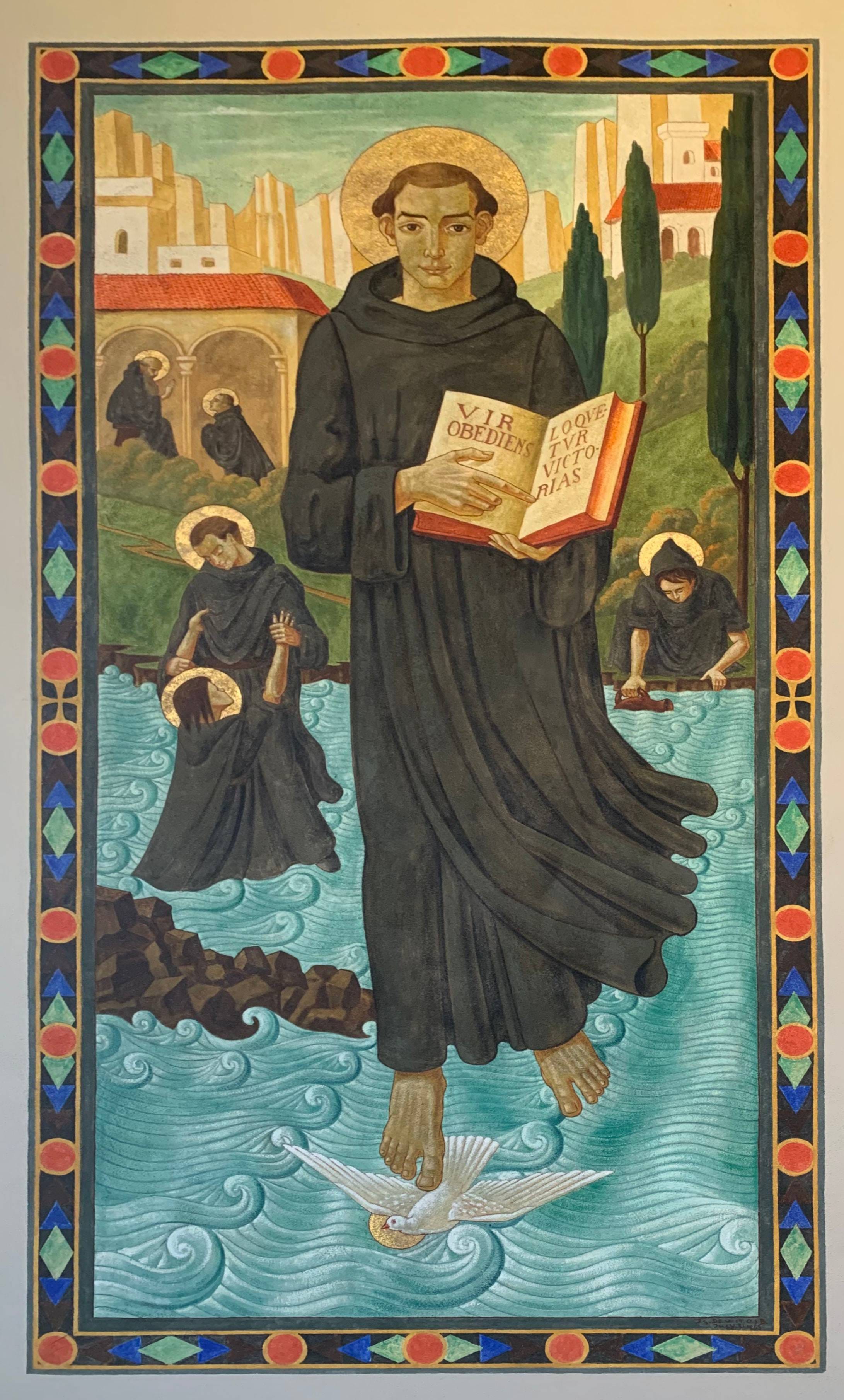
The story of Sts. Maurus and Placid by Dom Gregory deWit at St. Joseph Abbey
“The obedient man speaks victory” (Cf. Joshua 8:1-35)
And so it is with the history of art in sacred worship. I’ve always been drawn (pun intended!) to how many different ways a saint can be rendered: on a holy card, in a stained glass window, in a woodcut plate for a spiritual manual, even a cartoon. And yet there are archetypal elements that uncover that person for you whether you’re in Tokyo or Toronto. The carpenter’s tools held by St. Joseph, the roses and Carmelite habit of St. Therese, the stone held by St. Stephen, and the keys in the hands of St. Peter are good examples. And I’ve found that with these small elements, my imagination is able to “tell the story” no matter the artist. It’s a powerful united-yet-diverse way this Mystical Body is at work, with Christ as the head.
If we take St. Paul’s exhortation in his letter to The Philippians to heart: “Have in your mind the same that is in Christ Jesus…” then that means an artist is open to bringing his or her own gifts to the proclamation of the Gospel message that Christ willingly died for us and rose from the dead. His disciples down through the ages have magnified and amplified that in preaching, in martyrdom, and certainly through sacred art.
If that is the case, then you and I have our part to play. We have the ability to be like Dom deWit. We can take in ancient works told in frescoes and sculpture and combine them with our talents and imagination. We can then present them in a way that our heart and good discernment reveal. In this way, Eternal Truth can be authentically presented as an expression of the artist’s desire to create while standing on the shoulders of Sacred Tradition that has been telling the story of salvation in every age.
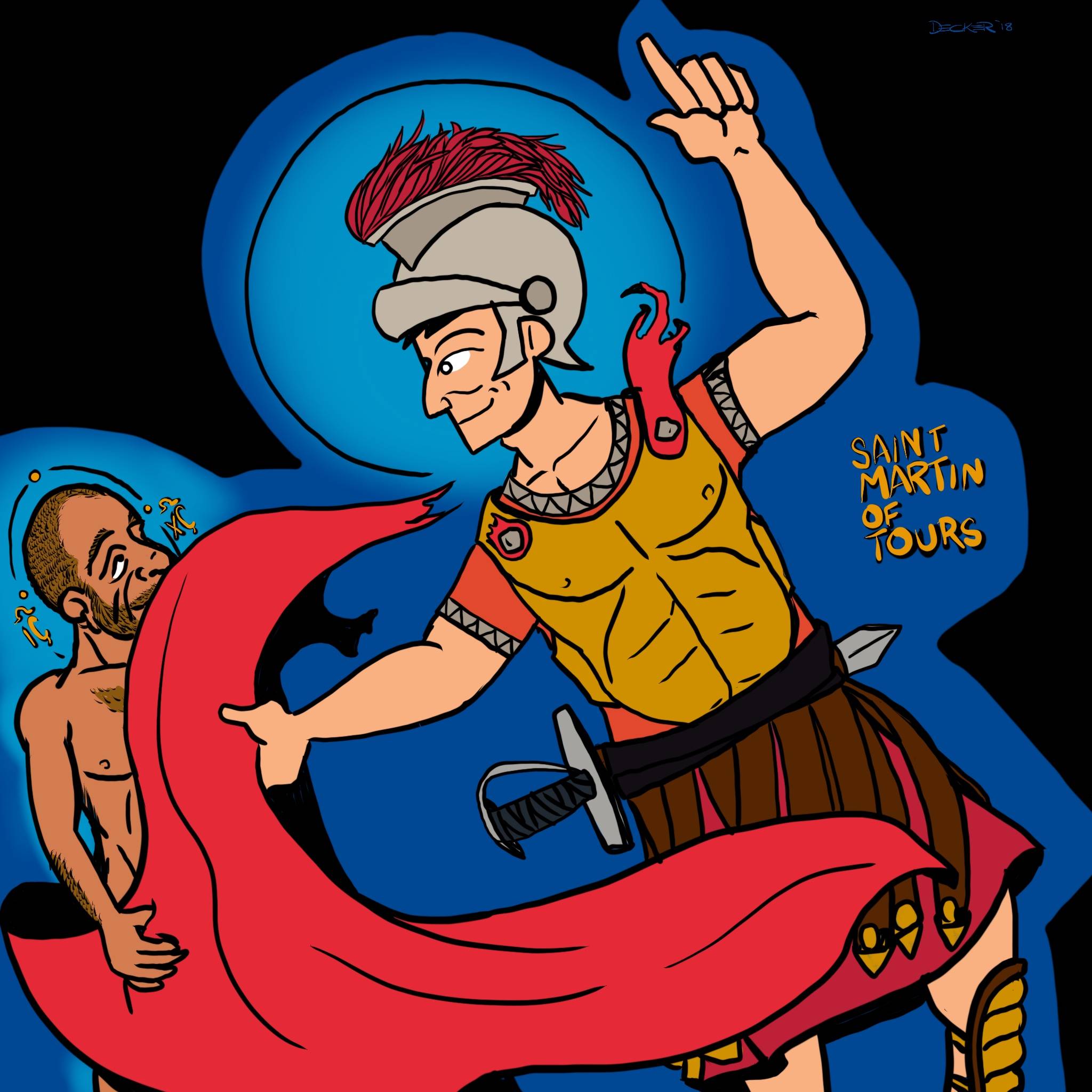
Here’s one of my illustrations of the story of St. Martin of Tours. It’s no Dom deWit, but there are hints of his style.
At least I think so.
Even though I won’t meet Dom Gregory on this side of Eternity, I am glad that he “stole like an artist” so that I was able to trace a thread of friendship across the ocean to encounter the saints and Our Lord in an intimate way.
Have you “stolen like an artist” tell a well known story in a unique way?
🔗 Pick of The Week
🔗 Montecassino Abbey – Cassino, Italy - Atlas Obscura
🔗 The Art of Dom Gregory de Wit – Art & Theology
Learn a little about Montecassino Abbey and maybe plan a visit. It’s very worth the trek up the mountain and then dive deep into deWit’s life and art over at Art and Theology.