This first appeared in my July 5, 2024 newsletter. Enjoy it again (for the first time). These are some of the inspirations that guide my writing and art.
SaintSpeak
“The love of God makes us do great things.”
– St. Philip Neri
Found Thoughts
Greetings! If you’re new to the newsletter and wondering why there hasn’t been any activity on it, it’s because this is my first article! If you’re popping into the blog, I don’t think I’ve posted since the new year began. Well, five months or so in seems like a good time to start!
I’m Fr. Chris Decker, a priest of the Catholic Diocese of Baton Rouge, Louisiana, in the United States of America. I am the pastor of a parish in a beautiful, small city called New Roads. It’s situated between the Mississippi River and an oxbow lake created from one of the great river’s course changes over the years. The lake is rather directly called ”False River”and has been the site that many people of faith and deep-rooted culture call home. I also provide administrative and pastoral care to a pre-Kindergarten through twelfth grade school attached to our parish. I really love being assigned as the priest here and am proud to call it home for the time that God has allows me to minister.
If you’ve ever been to Louisiana, you know that it’s got a particularly deep root system that interweaves food, faith, and family connections. A friend of mine has described Louisiana as “a dominion” meaning that in a bygone age, it could have been a great city-state (like a mini-country) unto itself because the culture is so diverse, yet united with strong family, cuisine, and custom. I’m inclined to agree! Despite all the struggles that people with varied backgrounds occupying the same places may have, there is far more that unites our state than should be allowed to divide it. It’s into that rich seedbed that I’ve been planted and has shaped my entire life.
So, that’s a brief introduction to the present day; enough about that for now! Since the purpose of my blog is to share my artwork, my reflections on faith and life, and how it might be helpful for you, intrepid reader, I thought I’d head down memory lane to look at how my love of religious art and my own style developed.
Art Roots & Influences
I’ve loved drawing from a very young age. My parents always made sure that art supplies were part of my childhood. It’s really interesting to me that today, friends can always pick out my “style” while I have trouble identifying it. Over the years, I’ve learned that it is a good practice to explore the artists and styles that have influenced one’s artwork. So, as we begin this newsletter and blog time together, I figured a good introduction would be to look at some of my influences.
As a youngling, I loved drawing airplanes (I somehow skipped over the dinosaur phase.) since my father worked for the airlines in customer service. When kids my age were attempting to draw fighter jets shooting each other down, I was mesmerized by the Boeing 767.
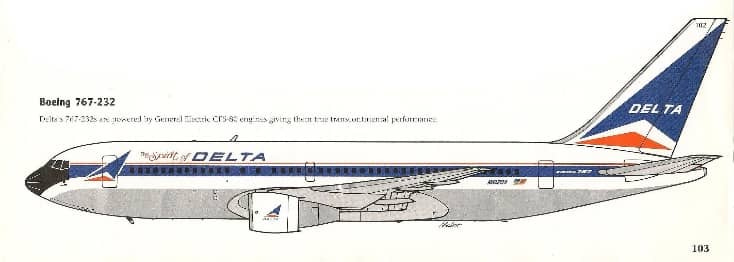
Mike Machat’s 767. Look at that precision and those clean lines!
Spending many days running around an airport (well before the TSA existed) gave me a lot to draw and fueled my imagination. In terms of influences, the nineties proved to be very influential! I was around 10 years old when my dad brought home Delta: An Airline and Its Aircraft : The Illustrated History of a Major U.S. Airline and the People Who Made It by R.E.G. Davies, illustrated by Mike Machat. It must have been a gift to employees. Wow! Suddenly, I didn’t just have to draw the airplanes from memory! Machat’s technical style and clean lines still influence my art today.
Long before I learned that sketching something out before going over it in ink and erasing the pencil sketch (pro-tip!) was even possible, I attempted to put a clean, finished line on the page. I wanted my first line to be the finished line. Admittedly, this has built in a great deal of perfectionism in my work and sometimes a ”failure to launch” out of fear of an imperfect line. But, after many years, I’m working through it. The only way to perfect art is to constantly make art!
Duck to the Future
Another great influence was the Disney style of cartooning. My favorite cartoon growing up was DuckTales. Unbeknownst to my kid self, it was a combination of Indiana Jones and some of the great works of literature for kids. It was also about this time I remember wandering into Waldenbooks (yep, I’m so old now!) in one of our trips to the mall (so old!) and finding a comic book on the spinner rack on which the DuckTales television cartoon was based: Uncle Scrooge.
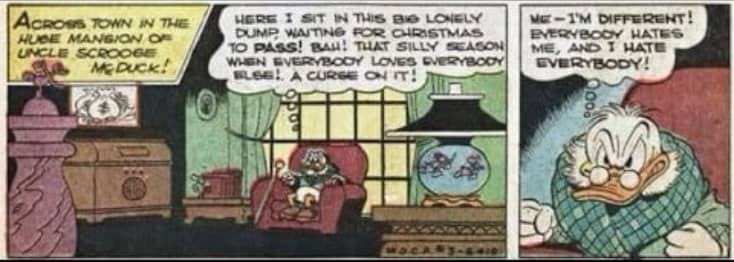
Scrooge McDuck’s appearance in “Christmas on Bear Mountain“, 1947 in Donald Duck #178. He was only a supporting character!
Invented, written, and drawn by Carl Barks, Uncle Scrooge first appeared in print in 1947. In the 90s, his original stories were being reprinted and sold. I switched from airplanes to trying to draw ducks almost immediately. Well, maybe it was ducks in airplanes. At any rate, before I tried to draw people, I was failing forward at drawing anthropomorphic fowl.
In the midst of the Disney Afternoon craze, where an entire block of after school programming carried DuckTales, Chip ‘n’ Dale’s Rescue Rangers, TaleSpin, and Darkwing Duck, I remember going to the supermarket with my mother and wandering down the cereal aisle to choose my favorite chocolate frosted sugar bomb (Cf. Calvin & Hobbes, another influence!). There was a mask on the back of one of the boxes that you could cut out and attach to a looped string. I wasn’t interested in the mask. I was interested in the front facing image of Scrooge McDuck.
(Wow. The internet remembers this as being from 1988. And someone on the internet was selling one! Crazy!)
It was the first time something clicked in my brain and I remember seeing the form of the drawing before I recognized the finished work. Suddenly, I could visualize the lines individually that made up the whole. I’d learn much later that this was the contour – the edge or outline – drawing that helped one to ”wrestle out” the form. Gosh, this was a skeleton key! All of a sudden I began looking at drawing differently. I can still draw that mask from memory.
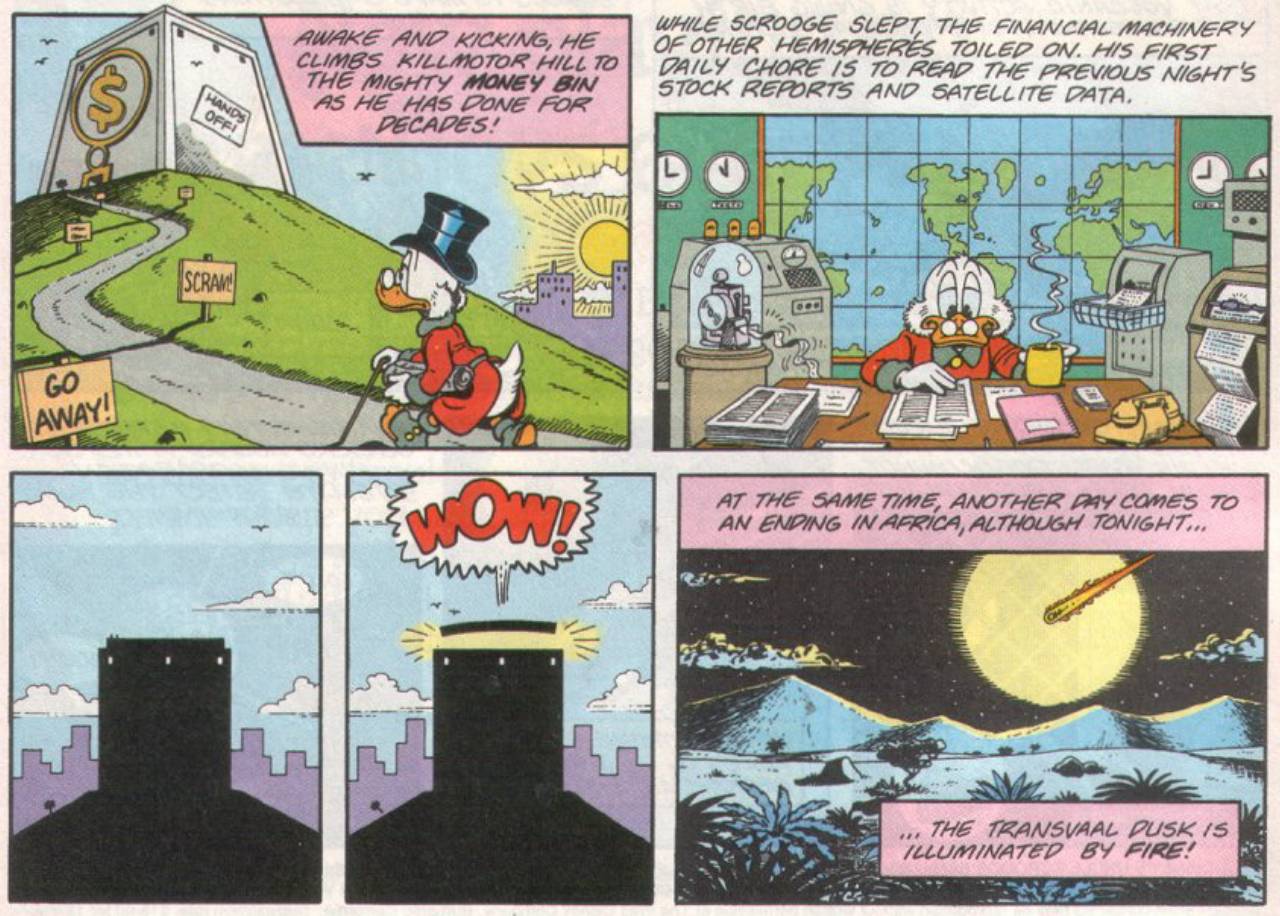
Later, the publisher began to carry the stories and art by Don Rosa, who also professed a love of Barks’ stories from a young age. Rosa bought a humor and technical perfection to his rendering of the Duck stories. Also, his artwork is always incredibly ”busy” with heavily rendered backgrounds complete with sub-stories going on while the characters are speaking in the foreground. My high school art teacher always called my artwork too busy and not composed. I suppose that’s what I was going for!'
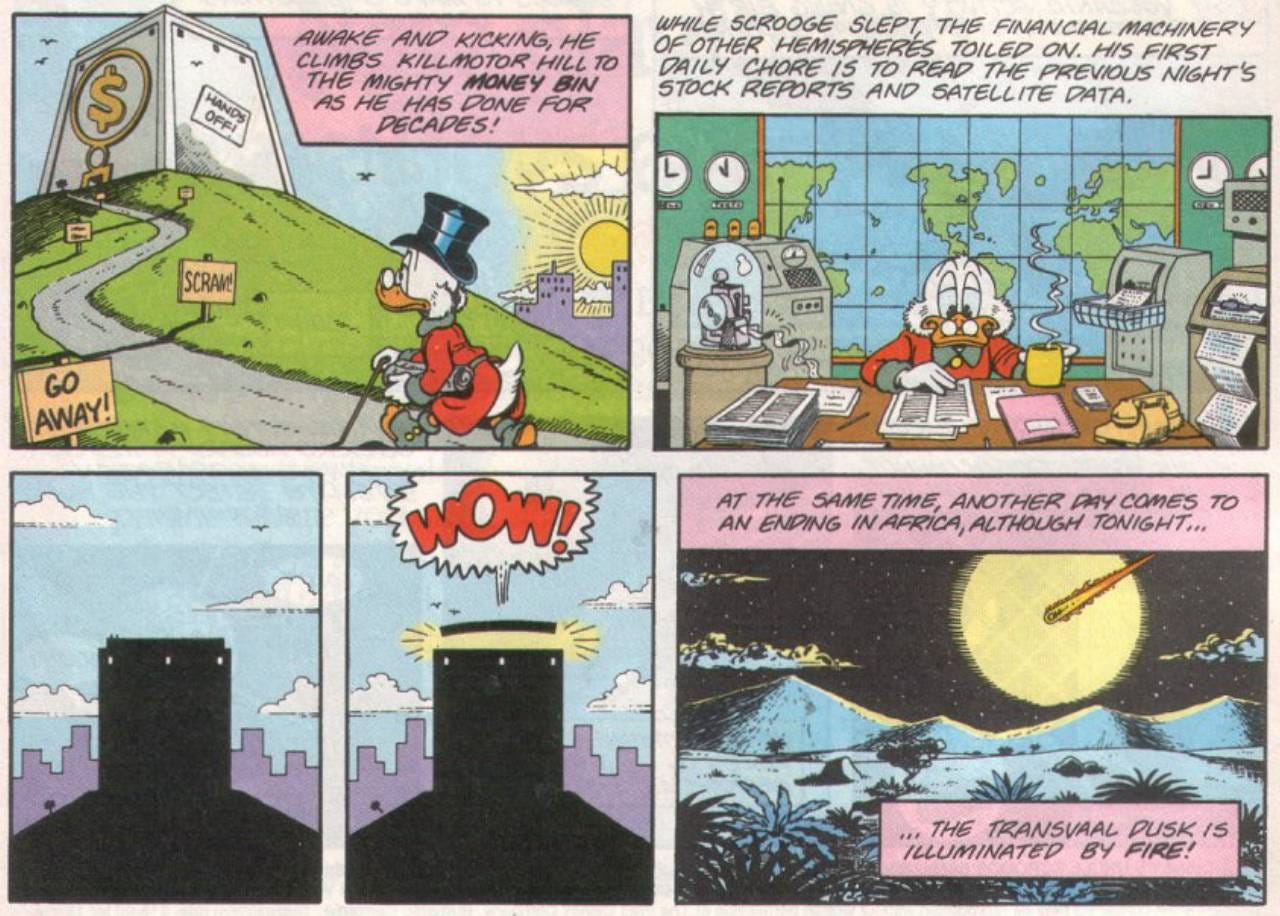 from ”Island at the Edge of Time” by Don Rosa in Uncle Scrooge #276 (1993). The art! The writing!
Middle School Challenge
In middle school, a shy student transferred into my school and I was glad to incorporate her into my friend group. I found out quickly that she had a much better intuition of the human form than I did. While I had been inventing duck-based characters, she was drawing dynamic poses of people in three-dimensional perspective. She was a Japanese animation fanatic! These were her first influences and it showed. It was loose and expressive and had clean, deliberate lines. The animation (often unapologetically gory) and storytelling didn’t particularly appeal to me, but I wanted to learn what she knew. Initially frustrated, I still thank her today for encouraging me. It’s very possible that some of my people today are a tip of the hat to her style.
Not all Ducks and Planes
Alongside airplanes, I’ve had an interest in the logos upon them (their livery, as it’s called) as well as designs for the television news presentation. When I was very young, my favorite book was Big Bird Follows the Signs. My parents said that one of my first words was “EXIT” since Big Bird used it to leave the opera and I recognized it in every public place, pointing with my little fingers. Today, I really like simple, clear shapes. Saul Bass, who designed the brands for AT&T, Continental Airlines, The Bell Telephone System, and so many more, is definitely an inspiration.
 Some of Saul Bass’ many many contributions to the world of logo and brand design.
I always liked the CBS television logo the best. The famous eye logo was only supposed to last a season, but became the brand image because it was so easily recognizable. (It wasn’t one of Saul Bass’ logos, but it sure could have been!)

The CBS “Eye” designed by William Golden
I do a fair bit more graphic design these days rather than traditional drawing, but as we shall see, they’re all quite related, especially when it comes to religious expression. I could go on about my influences into the present, but you’d be reading all day! Perhaps that will be a good topic to take up in future issues.
If you put pen to paper (or stylus to tablet), who are some of your influences? Have you ever thought about it?
Pick of The Week
🔗 The Etherington Brothers
Robin and Lorenzo Etherington are a UK based duo who are dedicated to making the world’s first free online encyclopedia of “How to Think When You Draw”. In the same way that duck mask on the back of a cereal box changed how I thought about drawing, Lorenzo does the same thing with his “learning by doing” philosophy of describing why things are drawn the way they are. His style is great and I’ve got the print copies of all of his books as an excellent resource and continuing education as an amateur artist. While I’ve got the books, their tutorials are “free forever” on their Blogspot page. Enjoy and learn!